
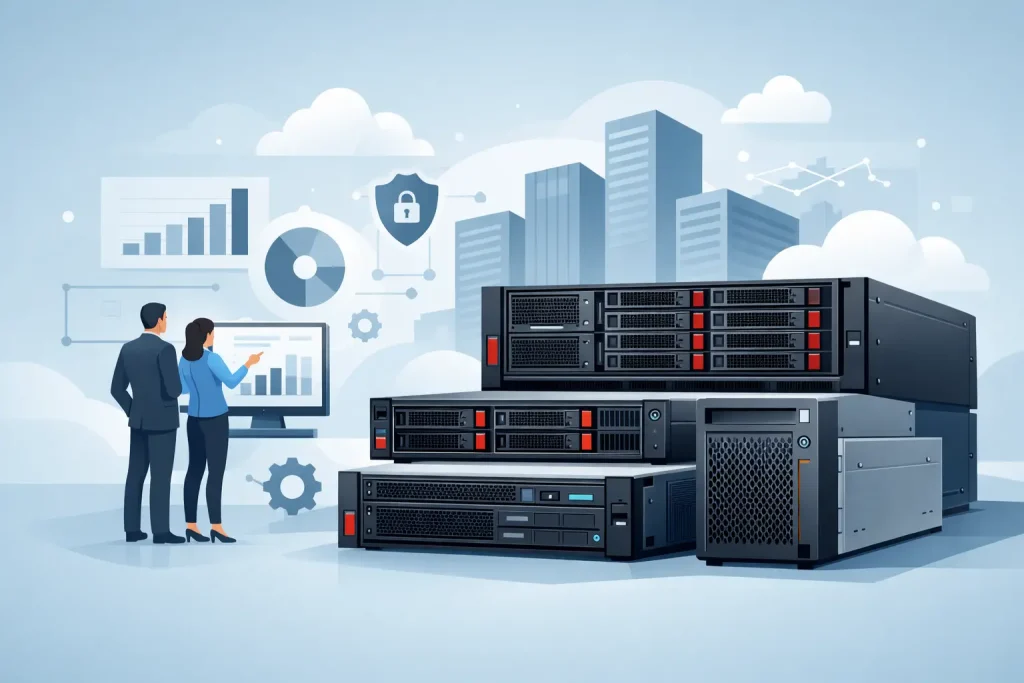
A server purchase is rarely about a single specification. IT teams need a platform that can support current workloads, accommodate growth, fit existing operations, and remain serviceable years after deployment. This Lenovo ThinkSystem server review examines where the platform performs well, where buyers should be selective, and how to choose a configuration that makes commercial and technical sense.
ThinkSystem is Lenovo’s enterprise server portfolio, covering rack, tower, high-density, and specialized systems. Its broad range is a major advantage for organizations that want to standardize on one vendor while supporting different use cases, from a compact branch office file server to a virtualized data center cluster or GPU-accelerated analytics environment.
Lenovo ThinkSystem Server Review: The Core Value
The strongest case for ThinkSystem is configuration flexibility without moving outside the enterprise category. Buyers can specify platforms around Intel Xeon Scalable or AMD EPYC processors, depending on the model and generation, with options for substantial memory capacity, NVMe storage, RAID protection, high-speed networking, and accelerator cards.
This matters because a server that is ideal for a virtual machine host is not necessarily the right system for backup, video processing, database workloads, or edge deployment. Lenovo offers multiple chassis formats and expansion profiles, allowing procurement teams to match the server to the workload rather than overbuying a generic configuration.
The portfolio is also supported by Lenovo’s established enterprise management tools and global service ecosystem. For organizations that value vendor accountability, documented component compatibility, and predictable support options, that is a more practical proposition than assembling a server from loosely matched parts.
Performance Depends on the Configuration
A ThinkSystem server can be an excellent performer, but the product name alone does not determine results. Processor selection, memory population, storage architecture, network throughput, and software design all influence the outcome.
For virtualization, dual-socket rack servers such as models in the ThinkSystem SR family are commonly considered because they can support high core counts, large memory footprints, and flexible I/O. A properly specified system can consolidate several aging hosts, reduce rack space, and give IT teams room for new virtual machines without an immediate hardware refresh.
For database and transactional applications, memory capacity and storage latency often matter as much as CPU frequency. NVMe SSDs can significantly improve responsiveness for workloads with frequent reads and writes, but they raise the initial cost. Organizations with lower IOPS requirements may achieve better value with a mixed design that combines SSDs for active data and larger-capacity drives for less frequently accessed information.
GPU-ready ThinkSystem platforms deserve separate evaluation. They can support AI inference, rendering, engineering workloads, and analytics, but power, cooling, physical space, and software licensing must be reviewed early. A GPU server is not simply a standard rack server with an accelerator added later. It should be planned as a complete platform.
Form Factors for Different Operating Environments
Lenovo’s range gives buyers several practical deployment paths. ThinkSystem SR servers are rack-mounted systems intended for data centers and dedicated server rooms. They are typically the best fit for organizations that need expansion, centralized management, and multiple servers in a standard rack.
ThinkSystem ST tower servers suit small offices, branch locations, and businesses without a dedicated rack environment. They can provide enterprise-grade processing and data protection in a familiar tower format, although they generally offer less density than rack systems. For a growing company with one or two core applications on-site, a tower platform may be the sensible starting point.
High-density systems in the ThinkSystem SD family are designed for organizations that prioritize compute density and scale-out deployments. These platforms are more specialized. They can be highly effective for cloud-like workloads, high-performance computing, and large clusters, but they require careful planning for cooling, power distribution, and operational support.
The trade-off is clear: more flexibility and density can create more design choices. Businesses with straightforward file, print, accounting, or small virtualization requirements do not always need the most expandable chassis. Selecting the right server begins with the workload, not the largest available specification.
Management and Serviceability
Remote management is a central strength of enterprise servers, particularly when equipment is installed across multiple offices or hosted at a location with limited IT staff. Lenovo XClarity Controller provides out-of-band access for monitoring hardware health, reviewing event logs, updating firmware, and performing remote management tasks. XClarity Administrator can extend that control across multiple systems.
For IT teams, this reduces the time spent reacting to basic hardware issues. A failed drive, power supply alert, temperature warning, or firmware requirement can be identified before it becomes a larger operational problem. It also supports more consistent standards across a fleet of servers.
Serviceability is another consideration that is easy to overlook during procurement. Enterprise systems are designed for replacement of common components such as drives, power supplies, and fans with minimal downtime when proper redundancy is in place. Tool-less access and clear internal layouts can make routine maintenance less disruptive, but the exact capability varies by chassis and configuration.
Buyers should confirm the support level, warranty coverage, replacement terms, and availability of compatible spare parts before approving a purchase. Hardware quality is only one part of continuity. Fast, knowledgeable assistance when a critical component fails is equally important.
Security and Infrastructure Control
ThinkSystem servers include features that support a structured security posture, including secure boot capabilities, TPM support, firmware management, and options aligned with Lenovo ThinkShield security practices. These features do not replace an organization’s security controls, patching discipline, network segmentation, or backup strategy. They provide a stronger hardware foundation when used as part of a complete IT policy.
For regulated businesses and organizations handling sensitive operational data, firmware integrity and lifecycle visibility should be part of the buying discussion. A server should be deployed with a documented baseline configuration, current firmware, restricted management access, and a planned update process. This is especially relevant when servers host financial systems, customer data, intellectual property, or production applications.
Cost Considerations for Business Buyers
ThinkSystem pricing can vary considerably because enterprise servers are highly configurable. The lowest advertised starting price rarely reflects the final system needed for production workloads. Memory, RAID controllers, enterprise SSDs, redundant power supplies, network adapters, operating systems, support coverage, and installation services all affect the total investment.
The better procurement question is not simply, “What does the server cost?” It is, “What capacity, protection, and support will the business require over the next three to five years?” Buying too little memory or storage can cause an early refresh. Buying maximum capacity on day one can tie up budget in resources that are not yet needed.
A balanced configuration typically reserves reasonable expansion headroom while prioritizing the components that directly affect the workload. For example, a virtualization host may benefit more from additional memory and redundant storage than from an unnecessarily high processor tier. A backup server may prioritize capacity and network connectivity instead.
When ThinkSystem Is the Right Choice
Lenovo ThinkSystem is a strong option for organizations that need enterprise-grade compute with broad configuration choices, centralized management, and scalable deployment options. It is particularly well suited to businesses consolidating servers, upgrading virtualization infrastructure, deploying new applications, or establishing reliable on-premises capacity alongside cloud services.
It may be less suitable when the requirement is extremely simple and no local server management is desired. In those cases, a cloud service, managed platform, or smaller appliance may offer lower administrative overhead. Conversely, highly specialized high-performance environments should validate exact GPU, network fabric, storage, and software certification requirements against the selected model.
The most effective ThinkSystem purchase begins with a clear workload assessment, not a part number. EDRC Global helps business buyers evaluate processor, memory, storage, networking, and support requirements so the selected server supports real operational goals at a competitive price. A well-specified server should give your team capacity to grow, visibility to manage, and confidence that critical services have a dependable place to run.