
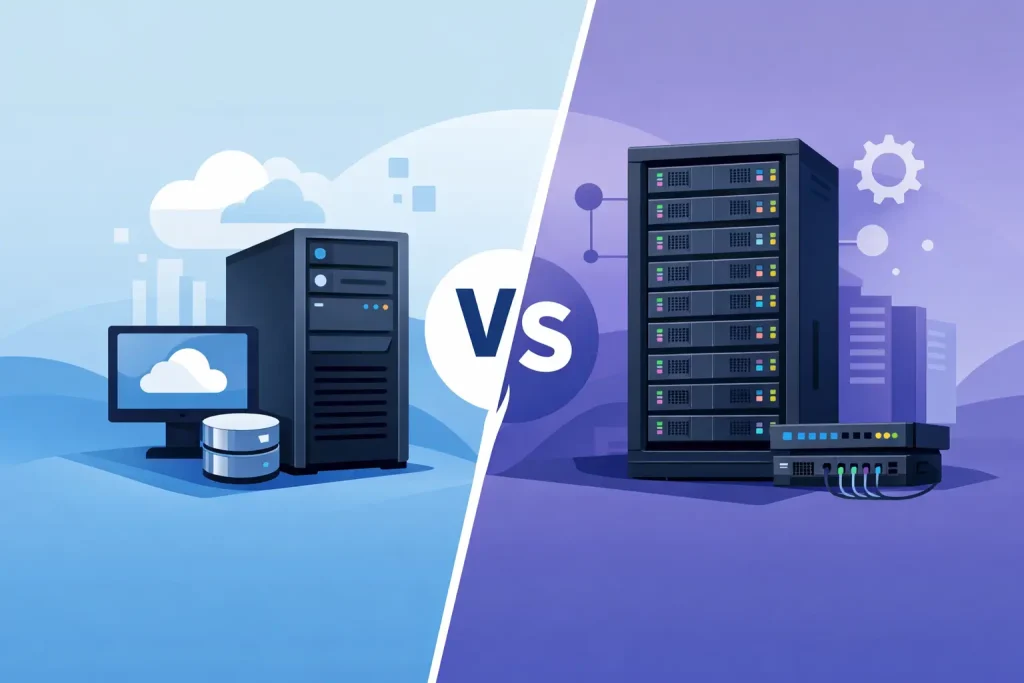
A server decision usually becomes urgent right after a business hits a limit – no more room for new users, slow application response, rising storage demand, or a branch office that suddenly needs local infrastructure. That is where the tower server vs rack question moves from technical preference to a real business decision.
For IT managers and procurement teams, this choice affects more than form factor. It shapes how easily systems can scale, how much space they consume, how they are cooled, how they are serviced, and how much the total deployment will cost over time. The right answer depends on workload, location, growth plans, and operational discipline.
Tower server vs rack: the core difference
A tower server is built in an upright chassis, similar in appearance to a traditional desktop workstation, though designed for server-grade processors, memory, storage, and management features. It is typically deployed as a standalone unit and does not require a server rack to operate.
A rack server is designed to be mounted inside a standard server rack or cabinet. It is measured in rack units such as 1U, 2U, or 4U, which define its height. Rack servers are intended for structured environments where multiple systems, switches, storage devices, and power accessories are installed together.
That means the tower server vs rack comparison is not just about size. It is really about deployment style. Tower servers suit simpler, lower-density environments. Rack servers suit organized, scalable infrastructure where centralization and space efficiency matter.
When a tower server makes more sense
Tower servers are often the right fit for small businesses, remote offices, retail branches, clinics, schools, and organizations with modest infrastructure needs. If the business needs one or two servers for file sharing, light virtualization, print services, backup, or a line-of-business application, a tower server can be a very practical choice.
One advantage is lower entry cost. A tower deployment does not require a rack cabinet on day one, so businesses can avoid some initial infrastructure spending. For leaner environments, that matters. A single tower server can be placed in a secure office, back room, or IT closet, provided ventilation and access control are handled properly.
Tower servers are also generally easier for smaller teams to deploy. There is less planning around rack space, cable routing, and cabinet power distribution. For companies without a dedicated data center or a full-time infrastructure team, that simplicity has value.
Noise can be another factor. Some tower servers are quieter than dense rack-mounted hardware, especially when running lighter workloads. That can make them more suitable for office-adjacent spaces, though this varies by model and configuration.
The trade-off is scalability. Once a business starts adding more compute, more storage, or more network equipment, separate tower systems can quickly become harder to manage. They take up more floor space, create less organized cabling, and make standardized service workflows more difficult.
When rack servers are the better investment
Rack servers are usually the stronger choice for organizations planning growth, centralized infrastructure, or higher-density workloads. If the environment already includes dedicated IT space, structured cabling, UPS systems, and multiple interconnected devices, rack servers typically offer the more efficient path.
Their biggest strength is consolidation. Multiple servers can be mounted vertically in a single cabinet, along with storage arrays, switches, KVM equipment, and power distribution units. That creates a cleaner and more manageable environment, especially for businesses running virtualization clusters, ERP platforms, databases, security systems, or mixed application workloads.
Rack servers also support better standardization. In a properly designed rack environment, airflow, cable management, service access, and physical security are more controlled. That is valuable for businesses that want predictable maintenance and faster hardware replacement.
For growing organizations, rack servers often reduce future disruption. Instead of redesigning the environment every time capacity increases, additional systems can be installed into existing rack space if power and cooling were planned correctly from the start.
The downside is that rack infrastructure adds cost and planning requirements. The server itself may not be the only purchase. Businesses may also need cabinets, rails, PDUs, patching considerations, and more disciplined cooling design. For a very small deployment, that can feel excessive.
Space, cooling, and noise considerations
Physical environment often decides the tower server vs rack choice faster than specifications do.
If the server will be installed in a branch office, reception-adjacent room, warehouse office, or small business location with no dedicated server room, a tower server may be easier to accommodate. It can operate independently and does not demand rack infrastructure.
If the business has a proper IT room or data center footprint, rack servers usually make better use of available space. They are designed for vertical density, which means more compute capacity in a smaller footprint. That matters in locations where floor space is expensive or limited.
Cooling is another major factor. Tower servers can be easier to place, but they are not automatically easier to cool. A poorly ventilated office closet can create thermal issues very quickly. Rack servers, on the other hand, are designed around front-to-back airflow and perform best in environments built for controlled ventilation.
Noise should not be underestimated. Rack servers, especially 1U and 2U systems under load, can be noticeably louder than tower units. In a true server room, that is expected. In a mixed office environment, it can become a problem.
Cost is more than purchase price
Many buyers begin with hardware cost alone, but the better question is total deployment cost over the expected life of the system.
A tower server is often less expensive to introduce. There may be no immediate need for a rack cabinet, rails, or data center accessories. For smaller businesses with stable workloads, that can make tower systems the most cost-effective option.
Rack servers may require more upfront investment, but they can become more economical at scale. Once a rack environment is in place, adding capacity is often more efficient and operationally cleaner. Serviceability, cable control, and equipment density can reduce management overhead over time.
There is also the cost of future change. A business that starts with towers and later moves to a dense virtualized environment may end up replacing the physical layout entirely. In contrast, a business that knows it will expand across departments, locations, or application workloads may benefit from starting with rack infrastructure earlier.
Management, maintenance, and growth
From an IT operations perspective, rack servers usually support easier expansion and cleaner lifecycle management. They are built for organized fleets of equipment. Technicians can standardize deployment methods, label systems properly, manage cables more effectively, and work within a predictable physical layout.
Tower servers are easier when the environment is simple, but they become less efficient as hardware count grows. Five standalone towers in different corners of an office are harder to manage than five rack servers in one cabinet. Maintenance windows, troubleshooting, and hardware swaps all take longer when infrastructure is physically scattered.
Growth planning matters here. If the business expects to add users, increase virtualization, expand storage, or support more applications in the next two to three years, rack servers often provide the better foundation. If the expected workload is stable and local, a tower may remain the smarter and more economical choice.
Which workloads fit each option?
Tower servers are well suited to file and print services, Active Directory, branch office applications, backup targets, and lighter virtualization. They also work well in small organizations that need dependable server performance without committing to full rack deployment.
Rack servers are better suited to virtualization hosts, database workloads, application clusters, VDI environments, centralized backup infrastructure, and multi-server environments where switching and storage are part of the same architecture.
This is where brand and model selection matter as well. Enterprise platforms from HP, Dell, and Lenovo are available in both tower and rack formats, often with similar processor families, memory options, and management capabilities. The better choice is not simply the more powerful system. It is the platform that fits the business environment, support model, and growth path.
How to choose the right server format
A useful way to decide is to ask four direct questions. How many servers are needed today? How many are likely within 24 to 36 months? Where will the equipment physically live? And who will maintain it?
If the answer is one or two systems, limited growth, and no dedicated server room, a tower server is often the practical answer. If the answer includes multiple workloads, planned expansion, structured IT space, and centralized management, rack servers are usually the stronger long-term fit.
For many businesses, the smartest decision is not to chase maximum specification. It is to buy infrastructure that matches actual operating conditions. That is where experienced procurement guidance matters. A trusted supplier can help align server form factor, workload requirements, vendor platform, and budget without overengineering the solution.
EDRC Global Computers works with businesses that need that kind of clarity – not just product availability, but the right fit across performance, scalability, and procurement confidence.
The best server choice is the one that supports your business without creating avoidable cost or complexity later.