
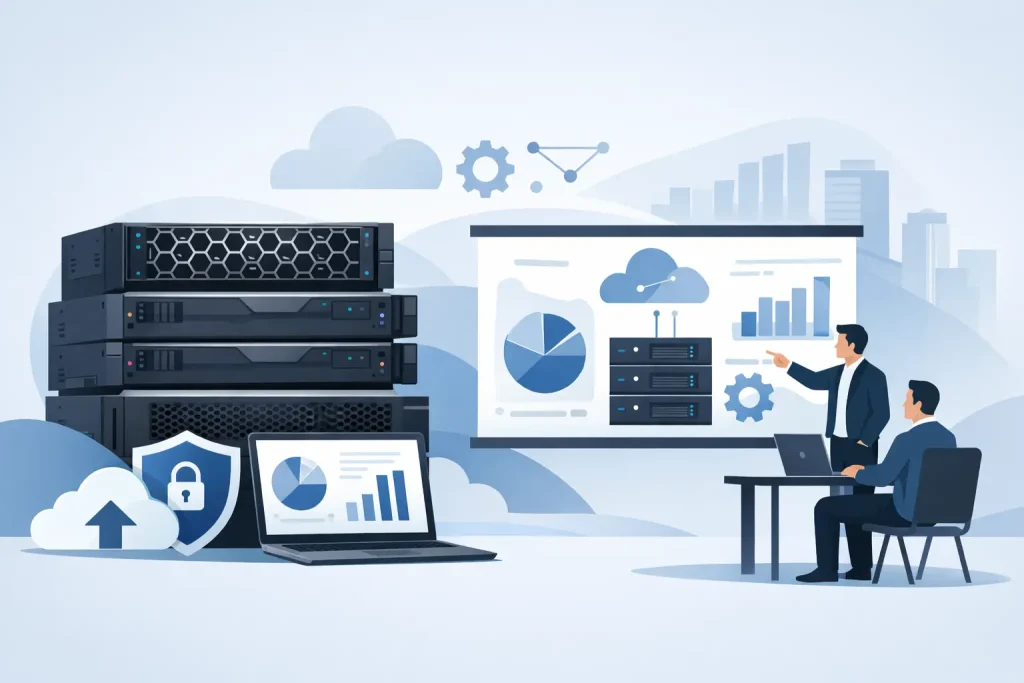
If you are evaluating server infrastructure for production workloads, a proper dell poweredge review starts with the question that matters most to IT buyers: will it hold up under real business demand without creating procurement or management headaches later. That is where Dell PowerEdge has built its reputation. Across tower, rack, and modular platforms, the range is designed for organizations that need dependable compute, broad configuration flexibility, and lifecycle management that fits both lean IT teams and larger enterprise environments.
For many businesses, PowerEdge stands out because it balances familiarity with depth. You can deploy an entry server for branch operations, scale into virtualization hosts, or standardize on dense rack systems for data center growth without stepping outside the same product family. That consistency matters when you are planning refresh cycles, training administrators, or trying to keep support and spare parts aligned across multiple locations.
Dell PowerEdge review: where it performs well
Dell has done a strong job making PowerEdge practical for business use rather than just impressive on a spec sheet. The platform is widely adopted because it covers a broad range of workloads, including file services, ERP, virtualization, backup, database hosting, VDI, and edge deployments. For procurement teams, that means fewer compromises when matching hardware to business need.
Performance is one of the clear strengths. Current and recent PowerEdge generations support modern Intel Xeon and, in selected models, AMD EPYC processors, with memory capacity and storage options that scale well from modest deployments to demanding enterprise environments. In practice, that gives IT teams room to configure around workload priorities. If your application needs more cores, high memory density, or fast local NVMe storage, there is usually a PowerEdge model that fits without forcing you into a completely different architecture.
The other major advantage is platform maturity. PowerEdge servers are not niche systems with limited ecosystem support. They are widely used, broadly certified, and familiar to infrastructure teams. That lowers risk during deployment and reduces friction when integrating with common enterprise software stacks, hypervisors, and backup environments.
Build quality and hardware flexibility
From a hardware perspective, PowerEdge systems are typically well engineered and easy to service. Tool-less access, logical internal layouts, and clean component organization help with upgrades and maintenance. In busy server rooms, that has real value. Faster serviceability means less downtime pressure and a smoother experience for internal IT staff or external support partners.
The product line is also flexible in ways that matter commercially. Tower models work well for smaller businesses, remote offices, and environments without dedicated rack infrastructure. Rack models cover the broader mid-market and enterprise requirement, where compute density, redundancy, and expansion options matter more. Some models are optimized for storage-heavy use, while others are more appropriate for virtualized compute or GPU-assisted workloads.
That said, flexibility can create complexity. A PowerEdge server is only as well suited as the configuration chosen. Processor selection, RAID controller, drive mix, memory layout, power supply redundancy, and networking options all affect real-world value. Businesses that buy purely on headline pricing can end up with a system that meets budget but not the workload. That is why specification guidance matters, especially for organizations trying to balance current performance with future growth.
Management tools are a major selling point
One of the strongest reasons businesses choose PowerEdge is not just hardware – it is management. Dell’s server administration tools, particularly iDRAC, have long been a competitive advantage. Remote management capabilities simplify provisioning, monitoring, firmware updates, and troubleshooting, which is especially useful for distributed organizations or lean infrastructure teams.
For IT managers, this can reduce the operational cost of ownership over time. A server that is easy to monitor and maintain is often more valuable than one that is slightly cheaper upfront but harder to support. Features like remote console access, hardware health visibility, and centralized lifecycle management can significantly improve response times when issues arise.
This matters even more in multi-site deployments. If you have branch offices, warehouse locations, or remote business units, remote administration reduces the need for on-site intervention. In environments where uptime affects revenue or customer service, that benefit carries weight.
How PowerEdge compares on value
A fair dell poweredge review should address value beyond acquisition cost. Dell PowerEdge is not always the lowest-priced option on paper, particularly when configured with enterprise storage, advanced RAID, higher memory density, or premium support. However, many business buyers do not choose servers on unit price alone. They look at support availability, configuration quality, component compatibility, and long-term reliability.
In that broader view, PowerEdge usually competes well. The product line offers a strong mix of performance, vendor credibility, and operational manageability. For organizations standardizing infrastructure across multiple workloads, that consistency can produce savings in administration, training, and lifecycle planning.
There is still an it depends factor. If your environment is very small and lightly loaded, a fully enterprise-grade configuration may be more than you need. If your workloads are highly specialized, another platform could offer a better fit in a narrow use case. But for general business infrastructure, PowerEdge is often a sound middle ground between capability and practical ownership.
Best-fit use cases for Dell PowerEdge
PowerEdge is especially well suited to businesses that need reliable infrastructure with room to scale. Virtualization is a common fit because the line supports strong CPU and memory configurations, flexible storage, and the redundancy expected in production hosts. It also performs well for line-of-business applications, Microsoft environments, private cloud foundations, and backup targets.
Small and midsize businesses often find value in tower or lower-density rack options because they can start with a right-sized system and expand over time. Larger organizations tend to benefit from the consistency of the platform across branch, core, and data center deployments. That makes procurement easier when you want a repeatable server standard rather than one-off purchases.
Edge and remote-site computing is another area where PowerEdge can make sense. Compact models and remote management features help support locations that do not have resident IT staff. For businesses balancing central control with distributed operations, that combination is attractive.
Trade-offs to consider before buying
No server family is perfect for every environment, and PowerEdge has trade-offs. One is configuration discipline. Because the portfolio is broad, buyers need clarity on workload demands before ordering. Overbuying can tie up budget in unused capacity, while underbuying creates expansion pressure sooner than expected.
Another factor is support strategy. Enterprise servers should be purchased with the right level of warranty and after-sales coverage for the business impact involved. A mission-critical system supporting core operations should not be treated the same way as a noncritical branch appliance. The hardware may be excellent, but support alignment is part of the overall result.
There is also the issue of refresh planning. PowerEdge generally holds up well, but businesses should think in terms of lifecycle, not one-time purchase. Processor generation, memory standards, storage interface choices, and virtualization roadmap all affect how long a system remains commercially efficient.
What business buyers should ask before selecting a model
Before committing to a PowerEdge configuration, the right questions are practical. What workload is this server actually supporting today, and what is likely to change in the next three years? How important are redundancy, remote management, and expansion capacity? Is local storage the priority, or will the server rely on shared storage? Will it run a hypervisor, host databases, or function as an application node?
Those questions shape the decision far more than brand preference alone. A file server for a regional office, a virtualization host for production workloads, and a backup repository all require different specifications even if they sit under the same product family.
For that reason, many organizations prefer to work with a trusted IT supplier that understands infrastructure sizing, compatibility, and commercial procurement requirements. The right guidance can prevent delays, avoid mismatched components, and make sure the final configuration supports both current operations and future expansion. For buyers that want competitive pricing with expert assistance, this is where an experienced partner such as EDRC Global adds practical value.
Final verdict on this Dell PowerEdge review
Dell PowerEdge remains a strong choice for businesses that want proven server hardware, broad configuration options, and management tools that reduce day-to-day operational burden. Its biggest strengths are consistency, scalability, and enterprise readiness across different deployment sizes.
It is not the right answer simply because it is well known. It is the right answer when you need dependable infrastructure, sensible upgrade paths, and a platform that your IT team can manage with confidence. If your next server purchase needs to support growth rather than just fill a rack space, PowerEdge is worth serious consideration.