
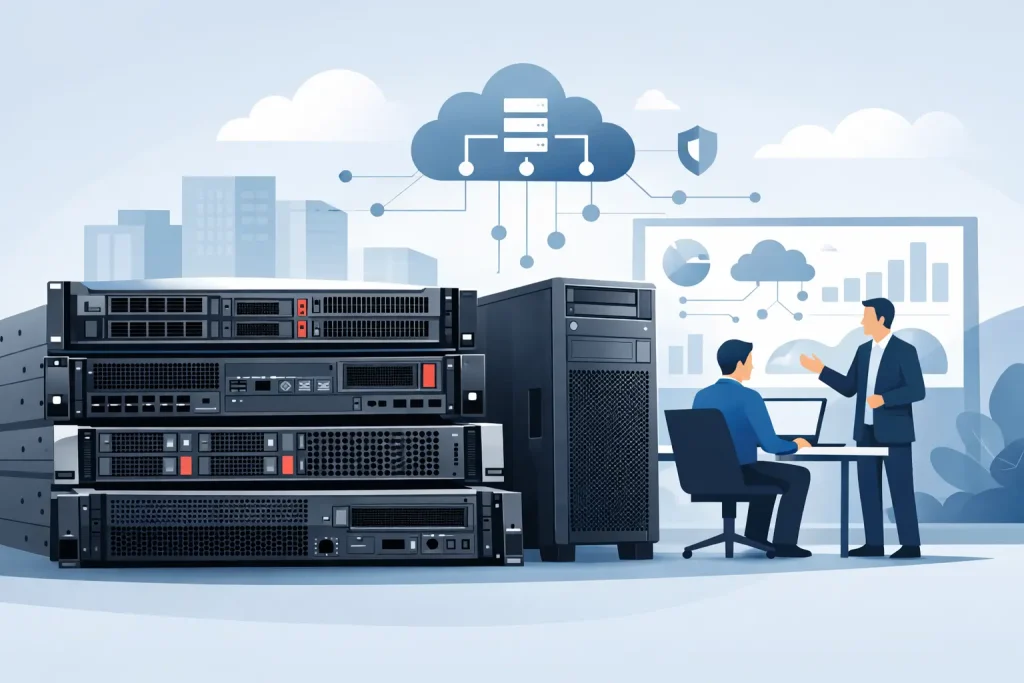
When a growing business starts hitting limits with aging infrastructure, the problem usually shows up fast – slower application response, tighter backup windows, rising virtualization pressure, and less room for expansion. Lenovo rack server solutions are built for exactly this point in the lifecycle, giving IT teams a practical path to add compute power, improve reliability, and keep future growth manageable.
For business buyers, the real question is not whether a rack server can add capacity. It is whether the platform fits current workloads, budget expectations, management standards, and long-term procurement plans. That is where Lenovo stands out. Its rack server portfolio is designed for organizations that need enterprise-grade performance without unnecessary complexity, and that balance matters whether you are supporting a mid-sized office, a multi-site operation, or a larger data center environment.
Why Lenovo rack server solutions appeal to business buyers
Lenovo has built a strong position in enterprise infrastructure by focusing on performance, efficiency, and operational simplicity. For IT managers and procurement teams, that translates into hardware that can support demanding business workloads while remaining straightforward to configure and scale.
One of the biggest advantages is breadth. Lenovo offers rack server platforms that fit a wide range of use cases, from general business applications and virtualization to database workloads, software-defined storage, and high-density deployments. That flexibility helps organizations standardize on one vendor while still matching server specifications to the actual requirement.
There is also a commercial advantage. In many purchasing cycles, buyers are balancing performance targets against strict budget controls. Lenovo often enters that conversation as a strong option for businesses that want enterprise features and dependable brand support while maintaining cost discipline. That does not mean every deployment should default to Lenovo, but it does mean the brand consistently deserves serious consideration.
Where Lenovo rack server solutions fit best
The best server choice always depends on workload, expected growth, and operational model. Lenovo rack server solutions are especially well suited for businesses running virtual machines, line-of-business applications, hybrid infrastructure, ERP platforms, file services, and backup environments.
For virtualization, rack servers with scalable processor options and higher memory ceilings can support consolidation goals without creating immediate resource bottlenecks. If the objective is to reduce physical server sprawl while maintaining room for new workloads, Lenovo systems can provide a solid foundation.
For database and transactional environments, storage configuration becomes just as important as compute. In those cases, the right Lenovo rack setup is not simply the one with the most CPU cores. It is the one that balances processor performance, memory capacity, and storage architecture in a way that supports the application profile. Fast storage, RAID considerations, and I/O expansion all play a role.
For branch offices or distributed operations, a compact rack server can also make sense where on-prem infrastructure is still required. Not every business is moving all workloads into the cloud, and many still need local application hosting, directory services, backup, or edge processing. In those scenarios, a rack server provides more controlled expansion than a tower unit while staying aligned with enterprise standards.
What to evaluate before you buy
A server purchase should not start with model numbers. It should start with workload planning. The most common mistake in procurement is buying on headline specifications instead of expected business use.
Processor selection is one of the first decisions. Some businesses need higher core counts for virtualization density or parallel application performance. Others will benefit more from fewer, faster cores. Memory planning follows closely behind. If your environment is likely to expand over the next 24 to 36 months, it often makes sense to leave room for future RAM growth rather than maxing out costs at the start.
Storage design deserves equal attention. Traditional hard drives may still be suitable for archival or lower-intensity workloads, but many business environments now benefit from SSD-based performance, especially for databases, virtualized applications, and fast recovery requirements. Capacity alone should not drive the decision. Latency, redundancy, and rebuild considerations matter just as much.
Network connectivity is another area that can be underestimated. As application traffic, storage movement, and backup operations increase, the server network design has to keep pace. Depending on the environment, that may mean planning for higher throughput interfaces or expansion options from day one.
Then there is manageability. Remote administration features, monitoring tools, firmware support, and integration with existing IT operations all affect total ownership experience. A lower initial purchase price can lose value quickly if management overhead becomes a recurring burden.
Performance is only part of the equation
Rack servers are often compared on speed, core count, or storage support, but long-term value comes from a broader picture. Reliability, serviceability, energy efficiency, and upgrade flexibility have a direct impact on operations.
A well-chosen Lenovo server can help reduce disruption because it is designed for business continuity. Redundant power options, enterprise components, and thoughtful chassis design all contribute to uptime. That matters for organizations where server downtime quickly affects users, revenue, or customer service.
Upgrade flexibility is another practical advantage. Businesses rarely buy infrastructure once and leave it unchanged for five years. New applications appear, virtual machine counts increase, storage grows, and user demands shift. A rack server platform that allows measured expansion helps protect the original investment and supports better lifecycle planning.
That said, bigger is not always better. Over-configuring a server can tie up budget that would be better allocated to storage, networking, backup, or warranty coverage. The right approach is to build around realistic demand with room for sensible growth.
Lenovo rack server solutions and procurement strategy
For procurement teams, infrastructure buying is not only about technical fit. It is also about sourcing confidence, compatibility, pricing discipline, and deployment readiness. This is where working with an experienced IT hardware supplier adds value.
Authorized sourcing helps reduce risk around product authenticity, warranty support, and configuration accuracy. For businesses that cannot afford project delays or compatibility issues, that matters more than a minor price difference from an unverified channel. It is one reason many organizations prefer to work with established procurement partners rather than treating servers as commodity purchases.
Configuration guidance is equally important. A server that looks correct on paper can still miss the mark if memory population, drive selection, RAID setup, network adapters, or power redundancy are not aligned with the environment. Expert assistance during specification can save time, avoid rework, and support faster deployment.
In practice, many buyers also want a single source for more than just the server chassis. They may need storage, switching, accessories, operating system licensing, or supporting infrastructure in the same purchasing cycle. A supplier with broad enterprise product coverage can simplify that process and reduce friction across approvals and implementation.
Choosing the right Lenovo rack server solutions for growth
Growth planning is where server decisions become more strategic. A business may only need one server today, but the better question is what the environment will look like after new users, new applications, or additional sites are added.
If you expect moderate expansion, choose a platform with practical headroom in memory, storage bays, and processor support. If the environment is likely to become highly virtualized, focus more heavily on CPU and RAM scalability. If data growth is the main pressure point, storage architecture and connectivity should move higher on the priority list.
Some organizations also need to weigh cloud strategy. Hybrid models are common, and on-prem rack servers still have a clear role where performance control, data locality, compliance, or application dependency make local infrastructure the better fit. In those cases, Lenovo rack servers can support a stable hybrid foundation rather than forcing an all-or-nothing approach.
For buyers who want dependable infrastructure with recognized brand backing, competitive pricing, and informed support, Lenovo remains a practical enterprise choice. At EDRC Global Computers, that is exactly how infrastructure procurement should work – not as a generic transaction, but as a carefully matched solution built around business continuity, scalability, and long-term value.
The right server purchase should make your next expansion easier, not create your next limitation.